Enterprise Resource Planning (ERP) systems are no longer just tools for large corporations—they’re becoming vital for businesses of all sizes in Guyana. From retail to construction, financial services to manufacturing, organisations are turning to ERP solutions to streamline workflows, reduce costs, and improve decision-making.
Yet, the journey of ERP implementation is rarely smooth. Many companies in Guyana face unique challenges ranging from infrastructure issues to resource constraints. The good news? With the right strategy—and the right ERP app development partner—these challenges can be turned into opportunities for growth.
In this blog, we’ll explore the most common ERP implementation challenges in Guyana and provide actionable insights on how to overcome them.
Challenge 1: Limited IT Infrastructure
The Situation:
While Guyana’s digital landscape is growing, many organisations—especially in rural areas—still operate with limited internet connectivity and outdated hardware. This makes ERP implementation a daunting task.
The Solution:
- Choose cloud-based ERP solutions instead of on-premise systems to minimise dependence on expensive servers.
- Partner with app development services that specialise in lightweight, scalable ERP applications optimised for variable bandwidth conditions.
- Conduct infrastructure audits before implementation to address gaps early.
Pro Tip: A modular ERP app designed for low-resource environments ensures smooth adoption without straining existing systems.
Challenge 2: High Implementation Costs
The Situation:
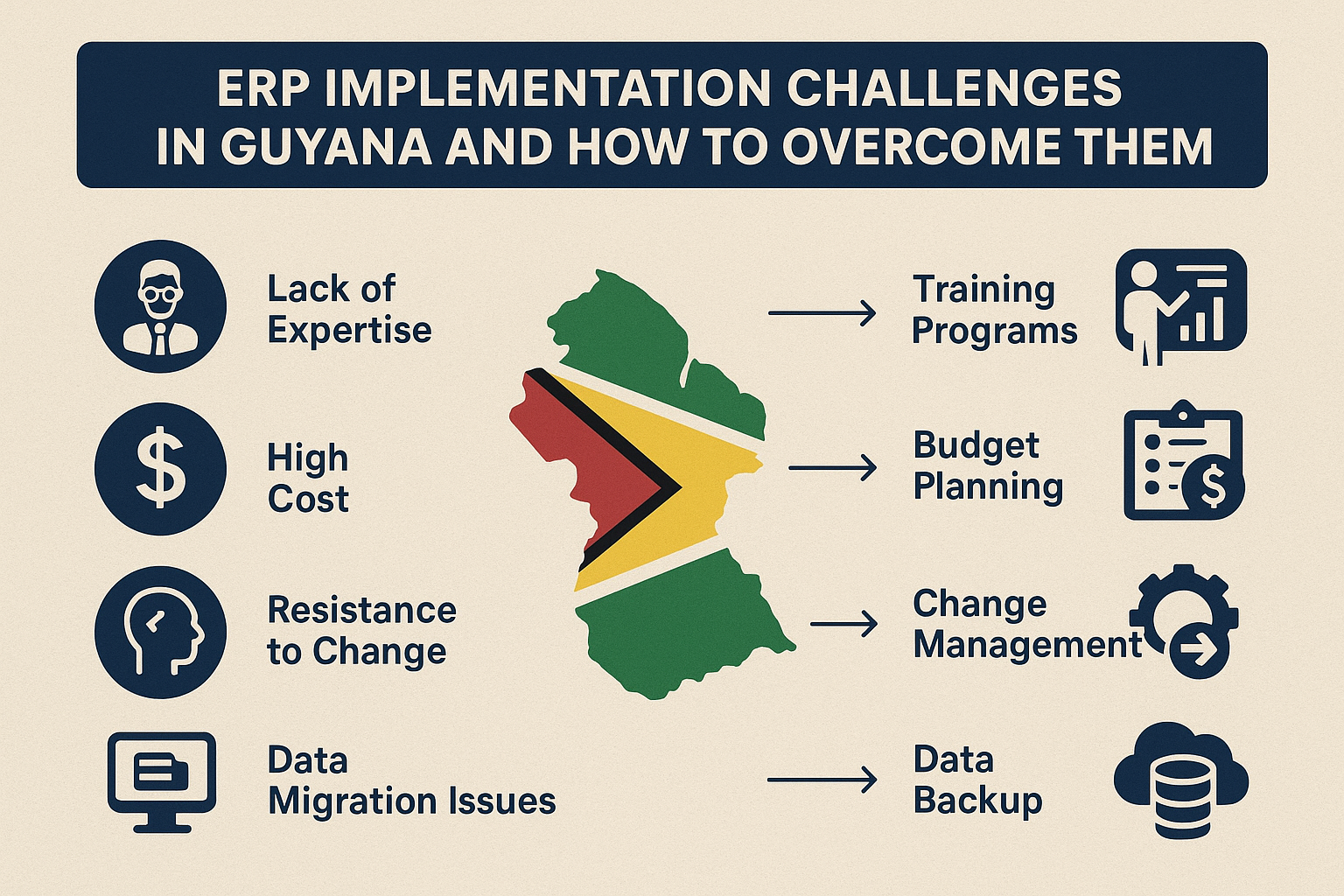
ERP implementation requires significant investment—not only in software licenses but also in training, customisation, and maintenance. For small to mid-sized businesses in Guyana, this can feel overwhelming.
The Solution:
- Adopt a phased implementation strategy: start with core modules like finance or HR, and gradually scale to inventory, CRM, or supply chain.
- Opt for open-source ERP frameworks or customised ERP app development tailored to business needs rather than paying for bloated, one-size-fits-all platforms.
- Leverage government grants or regional funding opportunities designed to support digital transformation.
Pro Tip: Spending smart, not big, is the key. Focus on ROI-driven ERP solutions rather than investing in features you won’t use.
Challenge 3: Resistance to Change
The Situation:
Employees may fear that ERP will replace their jobs, or they may be uncomfortable adapting to new systems. In Guyana’s close-knit work cultures, such resistance can stall progress.
The Solution:
- Prioritise training and hands-on workshops to build confidence.
- Involve employees early in the ERP selection and customisation process, giving them a sense of ownership.
- Use change management strategies, including internal communication campaigns that highlight the personal benefits of ERP (less repetitive work, fewer errors, more focus on strategy).
Pro Tip: Celebrate small ERP “wins”—like faster reporting or easier approvals—to build momentum and reduce scepticism.
Challenge 4: Lack of Skilled Professionals
The Situation:
Guyana’s growing IT sector still faces a shortage of ERP specialists who can design, implement, and maintain complex systems. Without expert guidance, businesses risk failed implementations.
The Solution:
- Partner with global app development services providers who bring ERP expertise and can train local teams in parallel.
- Invest in upskilling your IT staff with ERP certifications and hands-on experience.
- Use hybrid teams—local staff for day-to-day operations and external ERP consultants for technical complexity.
Pro Tip: Think of ERP implementation as both a technology and talent investment. Building in-house expertise ensures long-term sustainability.
Challenge 5: Customisation Complexity
The Situation:
Off-the-shelf ERP systems often don’t fit the unique regulatory, cultural, and operational realities of businesses in Guyana. Over-customising can lead to spiralling costs and endless delays.
The Solution:
- Focus on ERP platforms with strong localisation features and flexible APIs.
- Work with an ERP app development company that can tailor solutions to local tax rules, reporting standards, and business processes.
- Keep customisations minimal—prioritise features that truly impact efficiency and compliance.
Pro Tip: Avoid the “everything at once” trap. Successful ERP customisation is about simplicity and relevance, not adding every possible feature.
Challenge 6: Data Migration and Integration
The Situation:
Many businesses in Guyana still manage data through spreadsheets or legacy systems. Migrating this data into a new ERP platform can be error-prone and disruptive.
The Solution:
- Cleanse and validate data before migration to avoid “garbage in, garbage out.”
- Use ERP integration tools to connect existing apps—such as accounting software, POS systems, or HR platforms—with the new ERP.
- Run pilot migrations with limited datasets to test for accuracy before going live.
Pro Tip: Data migration should be treated as a project in itself, not an afterthought in ERP implementation.
Challenge 7: Ensuring Long-Term Adoption
The Situation:
Even after a successful ERP go-live, businesses in Guyana often struggle with long-term adoption. Employees may revert to old processes, or the ERP may not evolve with the business.
The Solution:
- Set up continuous improvement cycles, with regular feedback and ERP updates.
- Provide ongoing training and refresher courses to keep employees engaged.
- Collaborate with app development services to keep your ERP aligned with changing market and business needs.
Pro Tip: ERP is not a one-time implementation but a continuous journey. Regular upgrades and employee involvement keep the system relevant.
Final Thoughts
ERP implementation in Guyana presents both challenges and opportunities. Limited infrastructure, cost concerns, and skill gaps are real—but they can be overcome with careful planning, phased implementation, and the right partnerships.
By investing in ERP app development and leveraging reliable app development services, Guyanese businesses can unlock the true potential of ERP systems: improved efficiency, reduced costs, and smarter decision-making.
In the end, ERP is not just about technology—it’s about transforming the way businesses operate in Guyana’s rapidly evolving economy. Those who tackle challenges head-on will not just survive but thrive in the digital future.