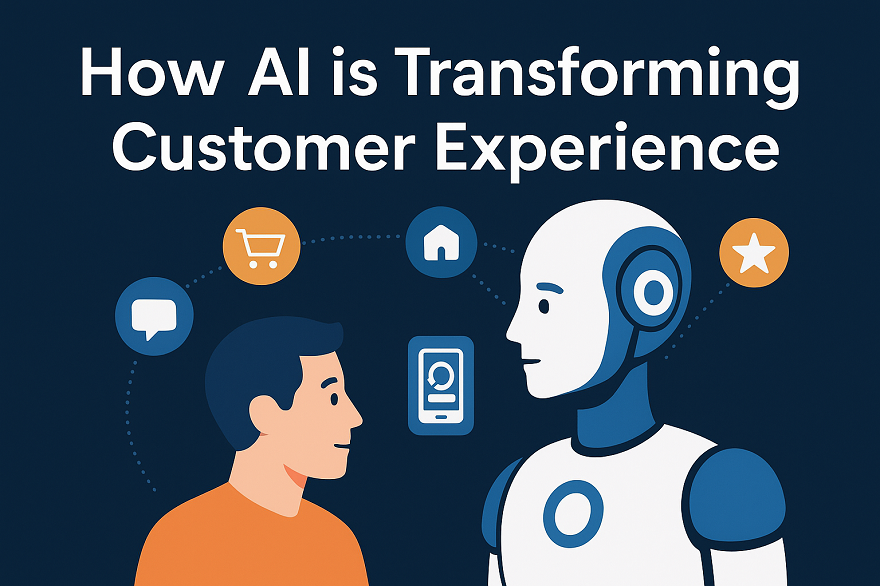
In today’s hyperconnected world, customer experience is no longer just a buzzword—it’s the competitive battleground. Every click, query, and complaint is a chance to build loyalty or lose it. Artificial Intelligence (AI) is emerging as the unseen hand that shapes these moments, enabling businesses to deliver experiences that are faster, smarter, and deeply personal.
Instead of diving into technical jargon, let’s explore how AI is reshaping customer experience through a story-driven lens: five real-world scenarios where AI quietly works behind the scenes.
1. The Personal Shopper That Never Sleeps
Imagine logging into your favourite e-commerce store. Within seconds, the homepage reshuffles—showing you items you didn’t even know you wanted. That’s not magic. It’s AI.
Through AI solutions powered by machine learning, platforms analyse your browsing history, purchase behaviour, and even social media activity to recommend products tailored to your taste. The experience feels personal, almost as if you have a digital personal shopper.
Impact on Customer Experience:
- Faster product discovery
- Reduced decision fatigue
- Increased customer satisfaction
For businesses, this translates into higher conversions and repeat sales—all thanks to AI’s ability to predict needs before customers even articulate them.
2. The Customer Service Agent Who Knows You
We’ve all experienced the frustration of repeating the same issue to multiple support agents. Enter AI-driven chatbots and virtual assistants.
Unlike traditional bots, today’s AI solutions are powered by Natural Language Processing (NLP). They don’t just respond with preloaded scripts; they understand context, learn from interactions, and can even predict the next question.
Example: A bank chatbot can not only block your lost card instantly but also suggest switching to a virtual card for faster replacement—streamlining the entire process.
Impact on Customer Experience:
- 24/7 availability
- Faster resolutions
- Human-like interactions without the wait
What’s fascinating is that customers often can’t tell if they’re talking to a human or an AI system—and that seamlessness is what transforms the experience.
3. The Invisible Problem-Solver
Sometimes, the best customer experiences are the ones customers never notice. AI excels at detecting issues before they escalate.
Consider an airline using AI to monitor flight data. If a delay seems likely due to weather, the system can automatically rebook passengers, send real-time updates, and even offer meal vouchers—all before the customer reaches the counter.
This proactive approach transforms potential frustration into appreciation. Customers may still face disruptions, but the way those disruptions are handled creates loyalty.
Impact on Customer Experience:
- Anticipated needs are met
- Stress is minimised
- Customers feel valued and cared for
4. Behind-the-Scenes: Employee Empowerment
Customer experience isn’t just shaped by technology—it’s deeply influenced by employees. That’s where AI quietly empowers teams through employee management software.
For instance, AI-powered tools can forecast staffing needs, optimise schedules, and track performance. A retail store doesn’t have to guess how many staff are needed during holiday rush hours—AI provides precise insights.
Happy employees create happy customers. When staff aren’t overworked, and they have the right tools at their fingertips, they can focus on what truly matters: human connection.
Impact on Customer Experience:
- Shorter wait times due to better staffing
- More engaged and helpful employees
- Consistent service quality across touchpoints
5. Turning Data into Delight
At the heart of AI’s transformation lies data. Millions of customer interactions generate oceans of information—most of it unstructured. AI doesn’t just crunch this data; it translates it into actionable insights.
Imagine a hotel chain using AI to analyse guest feedback from surveys, reviews, and social media. Instead of manually reading thousands of comments, the system identifies patterns: guests love the rooftop restaurant but dislike the check-in process.
Armed with these insights, the hotel improves the check-in flow while marketing the rooftop dining experience more aggressively. The result? Guests feel heard, and the brand builds trust.
Impact on Customer Experience:
- Personalized improvements
- Faster response to customer concerns
- Enhanced brand reputation
A Unique Shift: From Service to Experience
Traditionally, customer service was reactive—solve the problem when it arises. AI flips the script. It allows businesses to anticipate, personalise, and even humanise interactions at scale.
What’s unique is the holistic nature of AI’s impact:
- Front-end (customer-facing): Chatbots, personalisation engines, recommendation systems.
- Back-end (employee-facing): Employee management software, predictive scheduling, and AI-driven workflows.
Together, these elements create a seamless ecosystem where technology and humans work in harmony to deliver memorable experiences.
Challenges to Keep in Mind
Of course, no transformation comes without hurdles. Over-reliance on automation can make interactions feel impersonal. Data privacy is another critical concern—customers want personalisation without feeling surveilled.
The key lies in balance: using AI to enhance, not replace, the human touch. When deployed thoughtfully, AI becomes less of a “technology tool” and more of a customer experience philosophy.
Final Thoughts
AI isn’t just transforming customer experience—it’s redefining it. From anticipating needs before customers speak, to empowering employees with employee management software, to analysing oceans of data in seconds, AI solutions are quietly setting a new standard of excellence.
In the near future, customers won’t ask, “Is AI part of this experience?” They’ll simply expect every interaction—whether shopping online, booking a flight, or contacting support—to be effortless, intuitive, and personal.
Businesses that embrace this shift won’t just serve customers. They’ll delight them. And in today’s competitive world, delight is the ultimate differentiator.